
The short version: From January 2024 through October 2026, solar homes sold for about 0.8% more than similar non-solar homes in Central Texas (774 homes, about $3,500 on a $425,000 home) and about 1.3% more in North Texas (1,444 homes, about $5,000 on a $385,000 home). The premium acts like a flat $3,000–$6,000, with none seen above $750,000. The often-quoted 4% is a 2019 national Zillow study; the $15,000 figure traces to a 2015 Lawrence Berkeley National Lab study of 2002–2013 sales. A typical new 13.3 kW Texas system costs about $30,000 before incentives, and the 30% federal credit for homeowner-owned systems ended after 2025, so panels have returned roughly 12–17% of their cost at sale. Owned panels convey as fixtures; solar loans may carry a lien to release at closing; leases and PPAs must be assumed by the buyer. Correlation, not a guarantee.
If you list homes in Texas, you’ve heard it: “The panels added 4% to my home’s value.” Or “They told me solar adds $15,000.” Sellers hear those numbers at the kitchen table when the panels go on, and then they bring them to the listing appointment. So we checked what solar homes actually sold for.
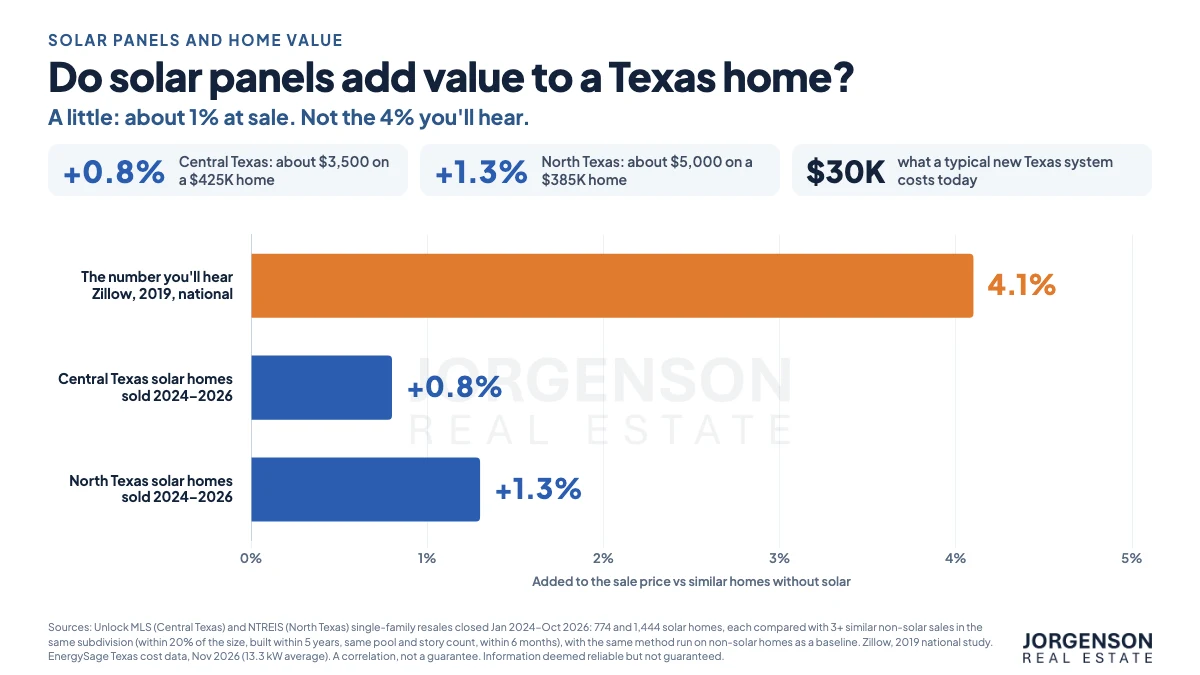
What Solar Homes Actually Sold For
We compared every solar home that sold from January 2024 through October 2026 with similar homes without solar that sold within 6 months: same subdivision, within 20% of the size, built within 5 years, and the same pool and story count.
- Central Texas (774 solar homes, Unlock MLS): solar homes sold for about 0.8% more, roughly $3,500 on a $425,000 home. They went under contract in about the same time.
- North Texas (1,444 solar homes, NTREIS): about 1.3% more, roughly $5,000 on a $385,000 home, and about 5 days slower to contract.
- It acts like a flat amount, not a percentage. Buyers paid roughly $3,000 to $6,000 more at most price levels. On homes $750,000 and up, we saw no premium at all.
Where the Bigger Numbers Come From
- “Solar adds 4%.” That’s a 2019 Zillow study of homes sold nationally in 2018 and 2019. It’s national, it’s seven years old, and Zillow itself noted that solar homes may have other features buyers pay for.
- “Solar adds $15,000.” That traces back to a 2015 Lawrence Berkeley National Lab study of sales from 2002 to 2013, which found about $4 per watt for owned systems.
Neither one is wrong for what it measured. They just aren’t Texas, and they aren’t today.
What a System Costs Now
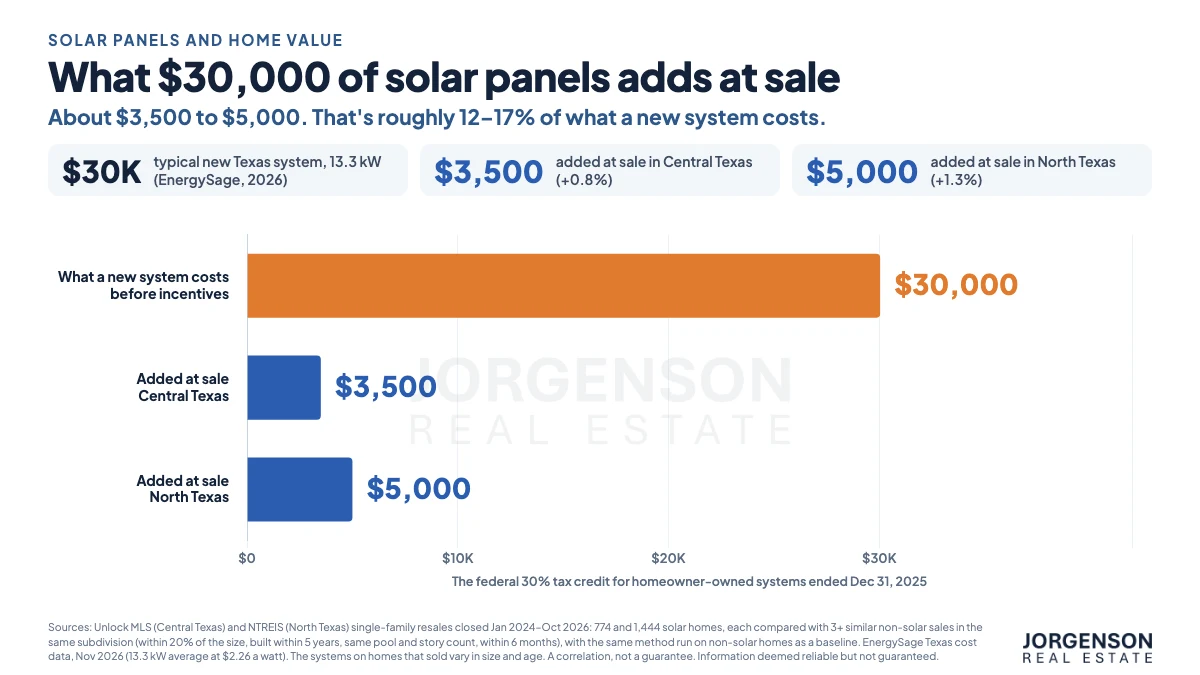
A typical new Texas system (about 13.3 kW) runs about $30,000 before incentives, and the 30% federal tax credit for systems homeowners buy ended for systems placed in service after December 31, 2025. At sale, panels have returned roughly 12–17% of what a new system costs.
What This Means If You’re Selling a Home With Solar
- Price from similar sales, not from what the panels cost. Buyers pay for the house. The panels add a little on top.
- Show the savings with real numbers. Twelve months of electric bills and the system details (size, install year, warranty, and the monitoring app) sell better than any estimate.
- Adding solar just to sell rarely pays. About $30,000 in, about $3,500 to $5,000 back at sale.
Owned, Financed, or Leased: Ask on Day One
This changes the whole transaction, so agents should ask it at the listing appointment. In general:
- Owned and paid off: the panels convey with the house like any other fixture. Hand the buyer the warranty and system documents.
- Financed with a solar loan: there may be a lien on the panels that has to be paid off or released at closing. Bring the title company in early.
- Leased, or a power purchase agreement: the buyer has to take over the contract, usually with the finance company’s approval. Get the contract, the monthly payment, and the end date up front.
Every deal is different. Questions about a specific lease, lien, or contract should go to your listing agent or broker. Our agents have the full playbook in our Knowledge Base, including what to say when a seller brings up the 4%.
Source: Unlock MLS (Central Texas) and NTREIS (North Texas) single-family resales closed January 2024 through October 2026; each solar home compared with 3+ similar non-solar sales in the same subdivision within 6 months, with the same method run on non-solar homes as a baseline. The MLS doesn’t show each system’s size, age, or whether it’s owned, financed, leased, or paid off. A correlation, not a guarantee, and not a price estimate for any specific home. North Texas figures are market data only. Information deemed reliable but not guaranteed. General information, not legal or tax advice.
Sources
- Unlock MLS and NTREIS single-family resales, January 2024–October 2026 (Jorgenson Real Estate analysis, aggregates only)
- Zillow Research, solar panels and home sale prices (2019)
- Lawrence Berkeley National Laboratory, Selling Into the Sun (2015)
- EnergySage, solar panel cost in Texas (November 2026)
- SEIA, clean energy provisions in the One Big Beautiful Bill Act
General information, not legal advice. TREC says I can’t practice law, and I like my license. Run your specific situation past your broker or a real estate attorney.
← All Broker Notes · Get The Debrief monthly → · Talk with us →