
The short version: An option “extension” is a new option. Under Paragraph 7 of the TREC Amendment, the buyer pays the seller directly, not the title company, and the amendment has to be signed before the current option expires at 5 p.m. The 3-day delivery rule is only for the original option fee. Don’t extend for $0: use a real fee and keep proof it was paid.
Three or four times in the last couple of weeks, the agent on the other side of one of our deals didn’t actually understand how an option period extension works. So here’s the whole thing in plain English.
An “extension” is really a new option
When you “extend” the option period, you’re not stretching the old one. The old option ends and the buyer buys a new one, even though the amendment uses the word “extension.” Texas A&M’s Real Estate Research Center puts it the same way. That matters because of how it gets paid.
Different document, different payment rules
The original option fee lives in the contract. Under Paragraph 5, the buyer delivers the option fee to the escrow agent within 3 days after the effective date. If it isn’t delivered on time, the buyer doesn’t have the unrestricted right to terminate. Most agents know that rule.
The extension lives in the amendment, and the amendment is a different animal. Read the actual wording of Paragraph 7:
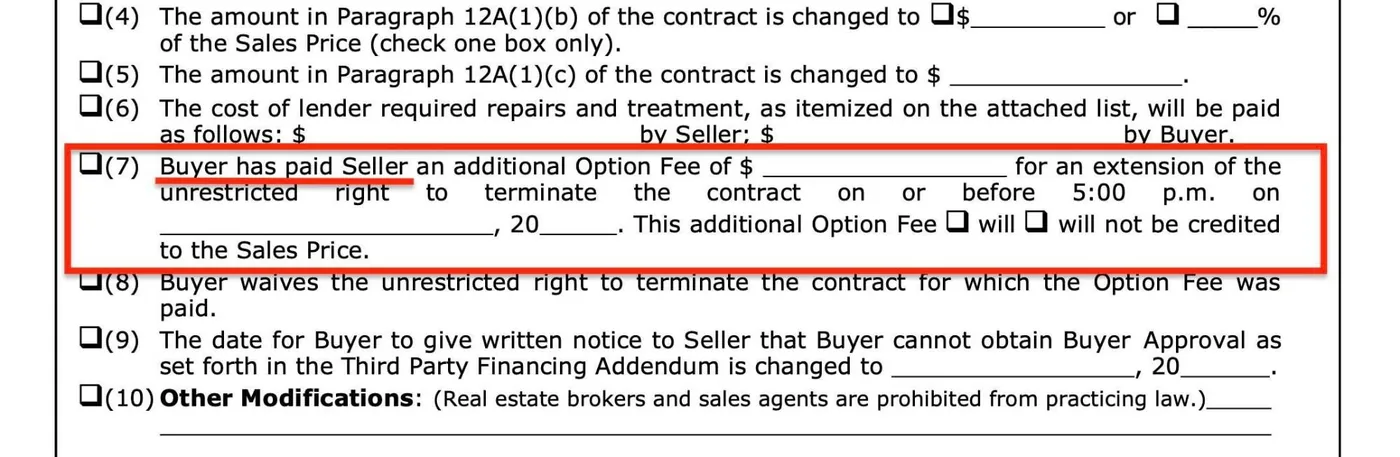
“Buyer has paid Seller.” Past tense, and paid to the seller, not the title company. That only works if the buyer has actually paid the seller directly by the time the amendment is signed. Both TAMU and Texas REALTORS say the fee goes straight to the seller, at or before signing. Zelle, Venmo, a check, cash: however the seller wants it, as long as you can prove it landed.
There is no “3 days to deliver to title” on an extension. That rule is in Paragraph 5 of the contract, not the amendment. When the other side tells you the extension money “has to go through title” or “you’ve got 3 days,” they’re grabbing a contract rule and slapping it onto a document where it doesn’t belong.
It has to be signed before the current option expires
The option ends at 5:00 p.m. local time on its last day. Texas REALTORS says the amendment must be signed by both parties before the original option period expires. Miss it, and the buyer’s unrestricted right to terminate is gone. From there, backing out without another contract right (like the financing addendum) can put the buyer in default.
You can’t extend for free
Not even if the delay is the seller’s fault. Texas REALTORS warns that leaving the fee blank or putting zero dollars “may lead to an unenforceable amendment,” and TAMU says the fee must offer something of value to the seller, “not just a token amount.” An amendment that bought the buyer nothing can mean no extension at all.
Is Texas law on option consideration black and white? No. The Texas Supreme Court has enforced an option where a small recited fee was never actually paid (1464-Eight, Ltd. v. Joppich, 2004). But that’s exactly the kind of argument you don’t want to be having over your client’s earnest money. Every attorney I know says the same thing: don’t let your transaction be the test case.
There’s no magic number, and the fee is always negotiable. A fair way to land on it: look at what the original option cost per day and price the new days the same way. Then pay it, deliver it, and document it.
Quick checklist
- It’s a new option period, not really an extension.
- Real, non-token fee, paid directly to the seller.
- Paid at or before signing, and signed before the current option expires at 5:00 p.m. on its last day.
- Keep proof of payment in the file.
- The 3-day, pay-to-escrow rule is for the original contract only.
Sources
General information, not legal advice. TREC says I can’t practice law, and I like my license. Run your specific situation past your broker or a real estate attorney.
← All broker notes · Get The Debrief monthly → · Talk with us →