
The short version: Since September 1, 2025, the agent and brokerage advertised on an illegal sign in a city or county right-of-way can be fined, not just the person who placed it: up to $1,000, then $2,500, then $5,000. The first violation gets a written warning; the second doesn’t. State highways (including every FM and RM road) are worse: no notice, and penalties can run per day. Private property with permission, or a city permit program like Round Rock’s, is the only safe place for a sign.
Drive any Central Texas arterial on a Saturday and count the open house signs stuck in the strip between the curb and the sidewalk. Most of them are illegal. They were illegal before last year, too, but on September 1, 2025, Texas changed who pays for them. The answer now includes the name printed on the sign, whether or not that person put it there.
That’s why some people call it the “ghost sign law.” The sign can show up overnight, placed by anyone, and the agent and brokerage advertised on it can still answer for it.
What House Bill 3611 changed
HB 3611 amended Chapter 393 of the Texas Transportation Code, which covers signs on the right-of-way of public roads such as city streets and county roads. Placing a sign there was already prohibited unless state law authorizes it, and on a city street the city has to authorize it (Transp. Code §§393.002, 393.0025). Here’s what changed:
- The advertiser is now liable, not just the installer. A civil penalty can now reach a person “whose commercial advertisement is placed on a sign” in the right-of-way, not only the person who placed or paid for it (§393.007(a)).
- “Person” was defined broadly. It includes a person’s employee, agent, independent contractor, assignee, business alter ego, and successor in interest (§393.001(1)). Most Texas agents are independent contractors of their brokerage.
- Penalties escalate. Up to $1,000 for a first violation, $2,500 for a second, and $5,000 for a third or later one (§393.007(b)). The old law was $500 to $1,000 per violation, with a separate penalty possible for each day it continued. HB 3611 removed that per-day language for these roads.
- The first violation comes with a warning. Before a city or county can collect a penalty for your first violation, it has to send written notice and give you a set amount of time to remove the sign. Remove it in time and there’s no penalty. The second violation has no warning requirement.
- Local prosecutors can collect. The district or county attorney, or the municipal attorney, where the sign was placed can sue for the penalty (§393.007(a-1)).
The older parts of Chapter 393 still apply too. Placing a sign in violation of the chapter is a Class C misdemeanor (§393.005). A sheriff, constable, or trained county volunteer can confiscate the sign, and you only get it back after paying any fines. Signs nobody reclaims are sold at public auction (§393.003).
Why your broker’s name is the problem
TREC treats signs as advertising, and every advertisement has to carry the broker’s name, at least half the size of the largest agent or team contact information. A directional sign is allowed to carry only the broker’s name or logo (22 TAC §535.155). In other words, a TREC-compliant open house sign advertises the brokerage by design.
Put that next to HB 3611 and the exposure is plain: the brokerage is the business whose advertisement is on the sign, and its independent contractors are included in the definition of “person.” Brokers are also required to keep written policies ensuring that every sponsored agent follows TREC’s advertising rules (22 TAC §535.2(i)(6)). If you run a brokerage and your agents are staking signs in medians, that’s your name on the sign and your policy on the line.
State highways are a separate, older law
HB 3611 only changed Chapter 393. Signs on a state highway right-of-way fall under Chapter 392, which it didn’t touch. There, TxDOT can remove a sign without notice (§392.033), placing or maintaining the sign is a Class C misdemeanor (§392.032), and the civil penalty is $500 to $1,000 per violation, with each day of a continuing violation counting separately. The Attorney General can sue too (§392.0355).
That matters here because so many of the roads we’d love to put a sign on are state highways. Farm-to-market and ranch-to-market roads are part of the state highway system, along with the U.S. and state highways that run through every one of our suburbs. No warning letter is required there.
“But nobody’s enforcing it”
Mostly true, so far. When I polled local agents on Facebook, 46% said they were aware of the law, 10% weren’t, and 44% picked “Aware & Don’t Care.” That last number tells you why the signs are still out there.
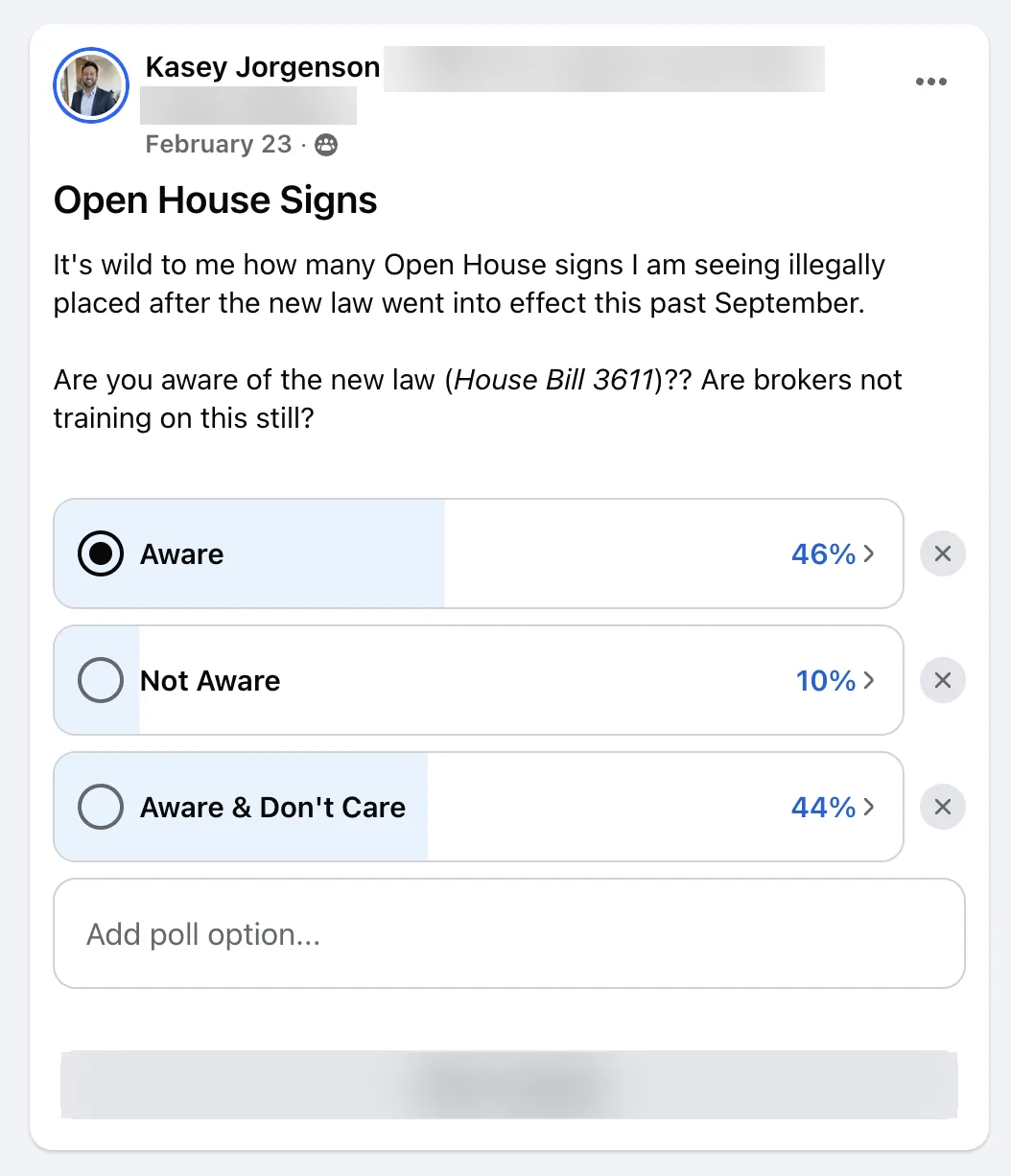
But the structure of the law is why it feels toothless, and it’s also why it isn’t. The first violation is a warning by design. That warning is the strike. After it, the next one can cost up to $2,500 and the one after that up to $5,000, with no letter first. And the statute doesn’t clearly say whether a warning from one city counts as your “first violation” everywhere. Don’t let your sign be the test case.
Cities are paying attention. Round Rock says its code enforcement team removes about 6,000 unauthorized signs a year, and several Texas cities announced crackdowns when HB 3611 took effect. Enforcement tends to arrive all at once, usually right after a city council meeting where someone complains about sign clutter.
What’s allowed around here
- Private property, with permission. The listing itself, or a neighbor’s yard with the owner’s okay. Get it in writing (a text works) and keep it. HOA common areas need the HOA’s permission, not just a homeowner’s.
- Round Rock’s open house permit program. Round Rock licenses open house directional signs in certain rights-of-way: a $5 sticker per sign, good for the calendar year. Signs are allowed Saturdays and Sundays from noon to 6 p.m. only. They must be 3 square feet or smaller and say “Open House,” with the agent’s name and picture, the address, and an arrow. They must point to a previously occupied home, not new construction, with one sign per property at each location. Signs can go on neighborhood local and collector streets, and where 14 listed arterials meet them, but not where those arterials meet a highway, an interstate, or each other. A sign without the sticker gets pulled.
- Georgetown. Temporary signs are prohibited in the public way, which the city says includes city streets, county roads, and state highways. The city’s rule of thumb is that the public way runs about 25 feet from the curb, and utility poles are usually inside it.
- Austin. The sign code (City Code §25-10-104) keeps signs out of the right-of-way, including medians, intersection corners, and the strip between the street and the sidewalk.
- Everywhere else. Check the city’s sign ordinance before you stake anything, and assume the answer for a median or a corner is no.
A quick checklist
For agents
- No signs in medians, corners, sidewalks, utility poles, or the strip between the curb and the sidewalk.
- Private property only, with the owner’s written okay saved in the file.
- On FM, RM, U.S., and state highways, there’s no warning letter. Just don’t.
- In Round Rock, buy the stickers and follow the weekend hours, or stay on private property.
- Pull every sign the minute the open house ends.
- If you get a notice letter, remove the sign that day and tell your broker.
For brokers
- Put sign placement in your written policies. TREC already requires an advertising compliance policy.
- Train on HB 3611 at onboarding and again before the spring market.
- Decide in advance who pays a penalty, and put it in the independent contractor agreement.
- Route every notice letter to one person and log it. The second violation is the expensive one.
How JRE handles it
Our independent contractor agreement includes a signage addendum. The public right-of-way is off-limits. Directional and open house signs go on private property only, with permission we can verify. We follow each city’s ordinance, keep a copy of the permission or permit, and remove signs right after the event. It isn’t complicated, but it’s written down, and that’s the point. If you want to work somewhere that trains on this kind of thing before it costs you, let’s talk.
Sources
- H.B. 3611 (89R), enrolled text
- H.B. 3611 bill history (signed May 29, 2025; effective September 1, 2025)
- House Transportation Committee bill analysis, C.S.H.B. 3611
- Texas Transportation Code, Chapter 393 (Outdoor Signs on Public Rights-of-Way)
- Texas Transportation Code, Chapter 392 (State Highway Right-of-Way)
- 22 TAC §535.155, Advertisements
- 22 TAC §535.2, Broker Responsibility
- City of Round Rock, Open House Signs
- Texas REALTORS, “Bandit Signs Are Still Illegal” (October 2025)
- City of Austin City Code §25-10-104 (signs in the right-of-way)
- City of Georgetown Code Compliance, bandit signs
General information, not legal advice. TREC says I can’t practice law, and I like my license. Run your specific situation past your broker or a real estate attorney.
← All broker notes · Get The Debrief monthly → · Talk with us →